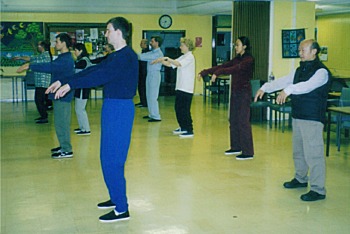
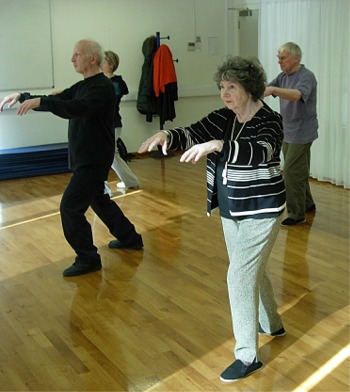
Still images from the DVD. This DVD contains seated exercises at three levels of challenge:




The writings of Lao Tzu who lived during the Jou dynasty (1122-934 BC) mention certain breathing techniques which would help people obtain good health. He wrote in his book 'Tao Te Ching':
This knowledge and understanding concerning energy has been understood for thousands of years in China. Surprisingly not many people know about it in the West. Only recently have books on the subject appeared in bookshops. Many, formerly secret, documents have been published giving greater insight into this unique and ancient art.
We know that air, water, food and warmth are needed to sustain life. The Chinese believe that Chi is also needed; without it our body's battery runs down. The most effective way of keeping a car battery charged is to drive the car periodically. Similarly, physical stimulation is for the human body the easiest method of building energy (Chi).
Millions of people practise Chi Kung and T'ai chi in China every day. In England one occasionally sees people in the park doing some form of Chinese health exercise. More knowledge and tuition is needed over here. Hopefully, in the future our parks will also be full of people practising many diverse exercise forms.
The Chinese Perspective
Some Chi Kung forms have been strongly discouraged in China as they are reported to affect mental stability. Their effect apparently is too strong for the human condition. In England, there are no reports of such conditions.
Chi Kung forms are generally taught for either health/meditation or martial purposes. There is a growing trend for T'ai chi practitioners to be more interested in the martial aspects of their art. Their Chi Kung training reflects this tendency. Their emphasis is more on stamina, endurance and strength as a way of enhancing the effectiveness of their techniques. Historians are of the opinion that Chi Kung for health predates Chi Kung for martial purposes.
Chi Kung in China
Chi Kung practice involves a variety of exercises, some moving, some static, some sedentary. Many of these can be done focused on the breath or in co-ordination with breathing. Different exercises will work in different ways. Some exercises are designed to stimulate the energy, some to concentrate the energy, and some to circulate the energy. Understanding the purpose of the exercises helps deepen and expand the student's practice and experience.
China offers a comprehensive health care system. It is reported that there are approximately 2,100 traditional medicine hospitals and an estimated one million traditionally trained doctors and pharmacists throughout China. Chi Kung is one of the means for treating diseases in these hospitals.
People are now beginning to realise that combining aspects of western and Chinese medicine may be the least invasive and most beneficial therapy available for patients. Western doctors generally look for physical or chemical abnormalities in a patient, while Chinese doctors search for hidden forces that may be out of balance.
The Chinese government, in order to reduce the cost of health care, has encouraged people to take part in physical exercise routines as a way of lessening the burden on the state. This is also a way of encouraging people to look after and maintain their health. Reports state that there are millions of people who daily perform Chi Kung and T’ai chi exercises.
How Chi Kung Works
It could be said that with aging there may be a decline in vitality and energy levels. Chi Kung exercises are specifically designed to cultivate vitality and increase energy. This is without doubt a valuable resource as we work towards quality of life. The goal of cultivating energy is a means to improved health. The calmness created by doing the exercises will help focus the mind and encourage inner stillness.
It is believed that the relaxation and the slowness of the movements give Chi Kung its healing properties. Chi Kung forms are repetitive in nature. This fact alone helps lull the mind into stillness. The brainwave patterns slow down. This takes the brain into what is called alpha brainwave pattern. It has been discovered that in this state healing occurs within the body. Healers find that their brainwave activity naturally goes into this state when they heal.
When practising Chi Kung movements it is important to be mindful in each moment. When the Chi Kung movements are done with the mind focused on the process, the most positive effect is encouraged. Chi Kung encourages relaxation and an increase in energy; both these factors encourage improvement in the immune system's capacity to deal with the negative effects of stress. When practising, be relaxed and calm so as not to interfere with the flow of energy and blood circulation throughout the body.
The Chinese believe that there is a close relationship between the flow of blood and Chi. Warmth is generated as a result of the increased circulation and the flow of energy. It is said that where blood and warmth go, healing occurs. Performing any Chi Kung exercise facilitates the body's ability to heal itself.
Research in China has shown that physiological changes happen with Chi Kung practice. This is especially the case with the standing static exercises. There is a change in blood chemistry. There is a considerable increase in white blood cell count as well as in red blood cell count.

CHI KUNG A way to improve health, vitality and well-being
This DVD gives you an introduction to Chi Kung. These Chinese health exercises are designed to increase your energy reserves. All the exercises on the DVD are easy to do.
You can purchase this DVD (Region 2, UK and Europe or Mulit-Region DVD Player compatible) for £14.99 with FREE p&p.
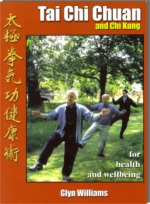
In this book, Glyn Williams takes you through easy to perform Chi Kung exercises and the Cheng Man-Ch'ing 37 posture Tai chi short form. With over 230 pictures detailing the various forms he explains the history, theory and benefits of these unique Oriental Arts.
168 pages.
You can purchase this book for £14.99 with FREE p&p.
These extracts are taken from Glyn Williams's book "Tai Chi Chuan and Chi Kung for Health and Wellbeing".
About Chi Kung
The discipline of Chi Kung is one of the most ancient approaches to emerge from China. Chi Kung means work on energy. Chi is energy, Kung is work. The most famous teacher of Chi Kung was the Buddhist Monk named Bodhidarma, or as he was also called, Da Mo. He came from India to China during the Liang Dynasty (502-557 AD). He stayed for a period of time at the famous Shaolin Temple. He perceived the monks to be weak and sickly so he taught them exercises, which improved their health and increased their strength. Many styles of Martial Arts teach forms of Chi Kung in order to improve the effectiveness of their techniques. Currently there are innumerable styles and systems of Chi Kung taught all over the world. This is a far cry from past times when Chi Kung was a very secretive art.
Only health related Chi Kung exercises were taught openly. In recent times books and publications have become more readily available on the subject, thus introducing Chi Kung to a wider audience.
In Chinese health circles the opinion is that everything in life is a manifestation of energy. They believe illness to be caused by either a blockage in the body's energy system or insufficient energy in the system in the first place. By unblocking or increasing the energy good health is encouraged. The Chinese have studied energy for thousands of years. The cycles of nature were recorded in the 'I Ching' (Book of Changes, 1122BC). This was probably the first Chinese book written about Chi.
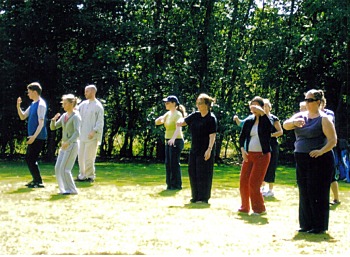
“Concentrate on Chi and achieve softness”
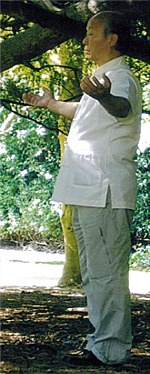
In the Chinese health system it is believed that one inherits a certain amount of energy from one's parents at birth; this is called prenatal Chi. This supply of energy is gradually used up throughout life. Some people inherit more than others do. The energy created by practising Chi Kung exercises adds to this existing level, helping to preserve natural vitality and youthfulness.
The ancient Taoists observed through their study that the aging process created certain conditions in people as well as nature. Among these were the loss of softness, pliability and vigour. The youthful qualities of liveliness, suppleness and flexibility were characteristics they sought to retain. They noticed children to be vibrant, malleable and energetic. They concluded that if the principles of youth could be maintained into advancing years, this would positively affect wellbeing.
A major factor in this equation from their perspective was energy. What was needed were ways of building up and storing energy. The Chi Kung exercises increased the level of energy and the ability to meditate helped conserve it. Many forms of Chi Kung are available to the general public.
Book: £14.99 FREE p&p
Book: £14.99 FREE p&p
Copyright Glyn Williams
DVD £14.99 + FREE p&p
DVD £14.99 + FREE p&p