Still images from the DVD. This DVD contains seated exercises at three levels of challenge:



T'ai chi these days is one of the most practised forms of exercise in the world. Parks in China and other eastern countries can be seen full of people practising various T'ai chi styles and forms. In the West, T'ai chi is gaining in popularity. Classes, clubs and adult education courses are seen more frequently. Forty years ago people may not have known what T'ai chi was; these days most people, including children, have heard of it and have a basic understanding of what it is.
Many styles of T'ai chi have emerged and been created over the years. T'ai chi's exact history, from its perhaps mythological origin to now, is rather obscure. There is tangible evidence of the presence of T'ai chi for at least 400 years. We know that T'ai chi was taught in the Chen village, Wen county, Henan province in central China in the 1600's. Chen Wang Ting (1597-1664) taught T'ai chi in the Chen village. It's not known if he created the form or learned it elsewhere. The T'ai chi form was taught as a secret within the Chen family through oral transmission over the years. Only family members and some disciples from outside the family were taught, in a secretive, cloistered environment. This particular Chen style is generally acknowledged to be the first style of T'ai chi developed but it is not known if it resembles what Chang San-Feng, if he existed, created.
The other styles of T'ai chi practised all over the world are said to owe their origin to the Chen style whether directly or indirectly. Some people studied with the Chen family and then created their own styles. Over time new forms came out of these styles as people experimented with concepts and ideas. There seem to be as many interpretations of the various T'ai chi styles as there are practitioners. People bring their own experiences, aptitudes, desires and needs into the equation.
There is a certain uniformity of opinion about the principles and general ideas involved within the art of T'ai Chi Ch'uan. Most observers will recognize if someone is practising T'ai chi or not, as there is a similarity to all the diverse forms. Many of the styles though, do have their own unique character and a particular way of performing the movements.
Certain family forms may be better at achieving specific goals, for example martial effectiveness, health giving benefits and meditational skills. All the different styles have the above-mentioned potentials. The individual's focus, aim and desire affects the outcome.
The Yang form of T'ai chi has become one of the most widely practised forms worldwide, mainly as a result of Yang Lu Chuan's grandson, Yang Cheng Fu (1883-1936). He altered some aspects of the family system. He slowed down the performance speed of the movements; he also made the transition between the movements more even. He removed the fast elements of the form as well as making the movements larger. All these factors made the form more accessible to the general public. The slow evenness of the movements had beneficial health effects, which also helped the form's popularity. The teaching of T'ai chi was at that time more open than it had been previously. This allowed more students access to the art which again helped in the expansion of T'ai chi.
One of the many students who studied with Yang Cheng Fu was Cheng Man-Ch'ing (1901-1975); he helped introduce T'ai chi to the West. Cheng's style is now a recognised style in its own right with great practitioners and teachers world wide popularising this unique form of exercise even further.
The healing qualities of T'ai chi have been well documented over the centuries. Even the 20th century's most renowned and respected Grandmaster, Professor Cheng Man-Ch'ing started the practice of T'ai chi as a result of ill health. T'ai chi, by its nature, is an ideal health exercise as it is moderate and slow. Some very strenuous activities can leave one feeling high and exhilarated, sometimes followed by exhaustion. In those cases the body has borrowed from its reserves of energy. T'ai chi, on the other hand, is always replenishing the body's reserves.
The low postures included in the T'ai chi form increase the body's demand and consumption of oxygen. Oxygen plays an important positive part in protecting the body from age related deterioration. The lower your oxygen consumption, the less vitality you will have, reducing your resistance to illness. A unique feature of T'ai chi is that it promotes mental as well as physical relaxation; it is often described as a form of moving meditation.
It has been confirmed through clinical studies in China that there is a connection between the practice of T'ai Chi Ch'uan and lower blood pressure. A Peking study compared two groups of over-50 year olds and found that the group which did T'ai chi had substantially lower blood pressure due to muscle relaxation, which helped establish a conditioned relaxation in the blood vessels, which lowered blood pressure. This relaxation also helps people with high blood pressure by countering over-activity in the cerebral cortex and vasomotor centre which regulates the size of blood vessels and may cause blood pressure to rise.
While performing the T'ai chi form emphasis is placed not on the breathing, but on the form; the low postures naturally increase the body's demand for oxygen. T'ai chi, if properly done, can improve blood supply to the muscles and to the connective tissues surrounding the joints, resulting in an improvement in the metabolic process in the cartilage, bone and muscle. Consistent practice makes joints more flexible and ligaments more elastic. Muscular strength is also increased.
The late Professor Cheng Man-Ch'ing considered health to be a prerequisite to anything else. He wrote, 'If one possesses only talent, without considering physical health as a worthy supplement, then what will be the outcome?' He believed that one's physical health should be equal to one's mental as well as physical talents.
.

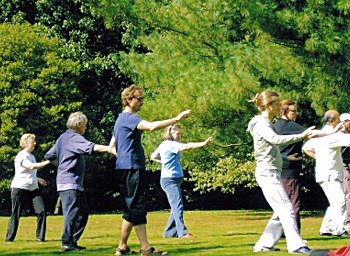
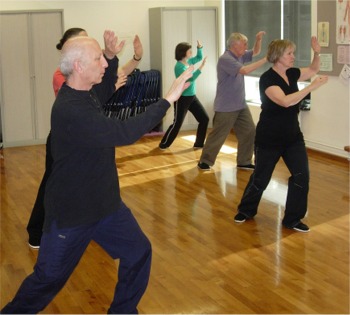
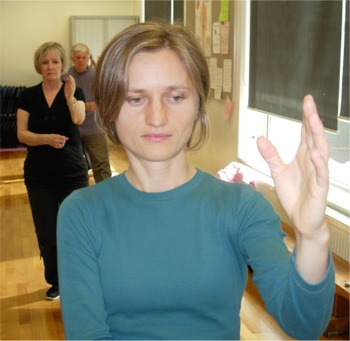
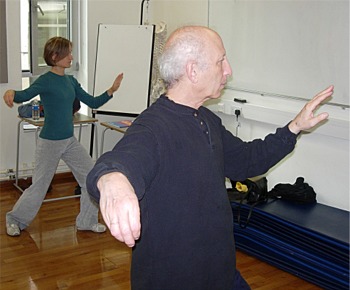
The Tai chi form shown on this video is the 37 posture Cheng Man-Ch'ing Short Form. Professor Cheng, one of the 20th Century's foremost teachers refined the form in order to get the most from its health aspect. Read more
You can purchase this DVD (Region 2, UK and Europe or Mulit-Region DVD Player compatible) for £24.99 with FREE p&p.
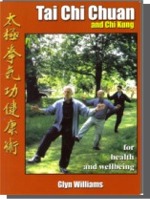
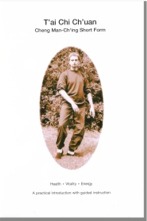
In this book, Glyn Williams takes you through easy to perform Chi Kung exercises and the Cheng Man-Ch'ing 37 posture Tai chi short form. With over 230 pictures detailing the various forms he explains the history, theory and benefits of these unique Oriental Arts.
168 pages.
You can purchase this book for £14.99 with FREE p&p.
These extracts are taken from Glyn Williams's book "Tai Chi Chuan and Chi Kung for Health and Wellbeing".
About T'ai Chi
T'ai Chi Ch'uan is generally acknowledged to have been created as a Martial Art. These days its popularity as a form of exercise is mainly attributed to its beneficial effects on health, fitness and wellbeing. T'ai chi's exact origin is unclear and unsubstantiated. An accepted theory about its origin is that a martial artist and Taoist priest by the name of Chang San-Feng, born in the 13th century, was seeking to create a new Martial Art. As he watched a snake and crane fighting he came to a realisation about circles and circular motion and how they could be applied in fighting situations. He observed the snake coiling in a circular manner away from the direct line of the crane's repeated attacks. It is said that from this enlightening moment came the formulation and creation of what is now called T'ai Chi Ch'uan.
£24.99 FREE p&p
Much is written about the founders of the new styles that have germinated out of the Chen form. The Yang style founder was Yang Lu Chuan (1799-1872). There are different versions of how he learned the Chen style. It was not initially from formal training but by spying on the Chen community doing their practice. Once caught he was brought in front of the Chen family master Chen Chang Hsing (1771-1853) to be punished. Yang was asked to show what he had learned. The level he had attained was higher than some of the Chen family members. He was then accepted as a student where he was taught formally in the Chen tradition.
Having completed his studies he then went on and taught and developed his own style, the Yang tradition. He became an accomplished martial artist and acquired the nickname of 'Yang the Invincible'. He taught his sons T'ai chi and they also became formidable fighters.
Book: £14.99 FREE p&p
Copyright Glyn Williams
£24.99 FREE p&p